ORP expresses whether water is easily oxidized or easily reduced in terms of potential. This will explain the differences in values due to reference electrodes, how to verify them, and their use in wastewater treatment.
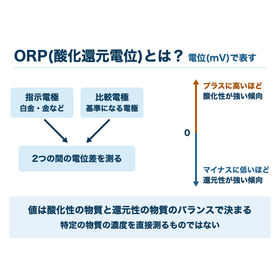
ORP (Oxidation-Reduction Potential) is an indicator that represents the degree to which a solution is prone to oxidation or reduction, expressed in millivolts (mV). The higher the positive value, the stronger the oxidizing potential, while the lower the negative value, the stronger the reducing potential. The value is determined by the balance of oxidizing and reducing substances in the water.
■ How is it measured?
An ORP meter measures the potential difference that arises between a sensing electrode immersed in water and a reference comparison electrode. Metals such as platinum or gold are used for the sensing electrode. There is also a method to switch a pH meter to display in mV and measure by connecting the metal electrode to the comparison electrode.
■ Does the value change with the comparison electrode?
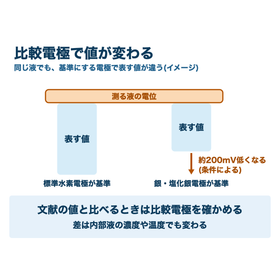
In electrochemistry, the potential of the standard hydrogen electrode is sometimes expressed as 0. On the other hand, industrial ORP meters widely use silver/silver chloride comparison electrodes. The values measured with this electrode are typically about 200 mV lower than those based on the standard hydrogen electrode, depending on the conditions. This difference can also vary with the concentration and temperature of the internal solution. When comparing with literature values, it is necessary to check which comparison electrode the values are based on. Please feel free to consult us first.